<?xml version="1.0" encoding="utf-8"?><feed xmlns="http://www.w3.org/2005/Atom" ><generator uri="https://jekyllrb.com/" version="3.10.0">Jekyll</generator><link href="https://new-yerk.github.io/feed.xml" rel="self" type="application/atom+xml" /><link href="https://new-yerk.github.io/" rel="alternate" type="text/html" /><updated>2024-12-11T21:50:05+00:00</updated><id>https://new-yerk.github.io/feed.xml</id><title type="html">Welcome to New Yerk!</title><subtitle>Write an awesome description for your new site here. You can edit this line in _config.yml. It will appear in your document head meta (for Google search results) and in your feed.xml site description.</subtitle><author><name>Yerkebulan Imanbayev</name></author><entry><title type="html">Digital Literacy Narrative</title><link href="https://new-yerk.github.io/dln/" rel="alternate" type="text/html" title="Digital Literacy Narrative" /><published>2024-02-08T00:00:00+00:00</published><updated>2024-02-08T00:00:00+00:00</updated><id>https://new-yerk.github.io/dln</id><content type="html" xml:base="https://new-yerk.github.io/dln/"><![CDATA[<h2 id="course-reflection">Course Reflection</h2>

<p>As a 21-year-old university student, I embarked on a transformative journey by enrolling in an introductory course in digital humanities. What made this experience particularly enriching was the diverse group of classmates who joined me. Our majors spanned a wide spectrum of disciplines, including Computer Science, Interactive Media, Film and New Media, Theater, Literature, and Creative Writing, and Music. Together, we have explored digital literacy, each bringing a unique set of strategies and skills into the classroom.</p>

<p>Before immersing ourselves in the world of digital humanities, we had already developed our own strategies for navigating the digital landscape in both daily life and academics. As an Interactive Media major, I was well-versed in coding languages such as Java and C++, using them for software development, physical computing, and robotics. My academic journey was marked by problem-solving, algorithm design, and collaborative coding through platforms like GitHub.</p>

<p>My peers from Film and New Media, Environmental Studies, Business and Marketing, and Literature and Creative Writing had their own digital toolkits. Film and New Media enthusiasts delved into multimedia production and digital narrative creation. Environmental Studies majors leveraged data analysis software for environmental research, while Business and Marketing students honed their skills in data analytics platforms for market analysis. Students in Literature and Creative Writing dived deep into research databases to fuel their literary and artistic pursuits.</p>

<p>However, the digital humanities course has illuminated the intersection of our diverse disciplines in the digital age. Content creation, once thought to be confined to specific fields, took on a multidisciplinary dimension. We explored creating interactive websites, digital art installations, immersive narratives, and AI-generated content. Our collaborative efforts showcased the power of interdisciplinary collaboration, blurring the lines between art, science, and storytelling.</p>

<p>The course involved a healthy blend of theoretical and practical work that refined my understanding of digital humanities more and more. Some of the sources used throughout the course, while being theoretical, had a very positive, practical impact on my digital literacy skill as they were designed just for that. One of such works was “Data Organization in Spreadsheets” by Karl W. Broman and Kara H. Woo. In this work, the authors delve into precise steps one can take to organize their data more effectively using spreadsheets, thereby improving their digital literacy. Not only were concepts such as “metadata” and “saving the data in plain text files” entirely novel, but they were also an indicator of how much more progress I could and should make in the realm of digital literacy.</p>

<p>Some of the theoretical resources were less tangible at first sight, but later on contributed to a greater understanding of what digital humanities comprises. “Art of the Sufis” by Courtney Stewart explores Sufism, the mystical facet of Islam, tracing its historical evolution, diverse practices, and cultural influence. It examines how Sufi beliefs and rituals have inspired artists and poets across centuries, emphasizing the significance of Sufi orders, initiation processes, and the enduring appeal of Sufi themes in literature and art. It also touches on the challenges faced by Sufi groups and their documentation by European travelers. This was not a source material I expected to encounter in a class about digital humanities.</p>

<p>However, a highly engaging lecture in which Amar Ahmad presented his artworks that were heavily inspired by, and in many ways dependent on, the concepts of Sufism showed the ways in which digital humanities goes beyond the analysis of data. It is the usage of that analysis to generate digital art that can cast a new light upon traditions and beliefs that are centuries old.</p>

<p>Social interaction and collaboration also evolved. Platforms like Google chats became hubs for exchanging ideas, sparking discussions, and collaborating on projects. We found ourselves engaging in thought-provoking conversations that spanned our areas of expertise, enriching our perspectives and generating innovative ideas. Collaborating across disciplines proved to be a catalyst for creativity and interdisciplinary thinking.</p>

<p>Research data management and manipulation emerged as a common thread that united us all. We delved into text analysis, data visualization, and digital archives. Tools like PositCloud became invaluable for organizing, annotating, and sharing research materials. The importance of data literacy transcended individual majors, equipping us to navigate the data-driven landscape of the digital age.</p>

<p>Another important tool that I would like to highlight is “Voyant Tools.” This is an open-source, web-based application facilitating text analysis for scholars, students, and the public, with a large international user base, supporting the interpretation of texts or corpora through features like scholarly reading and analysis of uploaded or online texts. By using this software, I completed an assignment that was of great personal interest. Using it, I analyzed three of Madonna’s most distinct sounding albums: specifically, the lyrics of all the songs on the albums. As described by Ama Bemma Adwetewa-Badu on the podcast “High Theory,” “distant reading” can provide an analyst with a great deal of quantitative information about literary works when they are read and analyzed from a bird’s eye view and in comparison to each other. This stands in stark contrast to the method we conventionally use when reading literary works, which is a close reading of each work and detailed analysis of the language of each work. Applying these principles, I began seeing the music of her albums as literary works. When listening to music, we tend to closely listen to and uncover the meaning of each record separately. However, the usage of “Voyant Tools” enabled me to “distant read” her music in order to notice any stark shifts in the very words she uses, as, after all, she is hailed as the “Queen of Reinvention.” Voyant Tools’ quantitative and comparative analysis of the language she uses uncovered that maybe her Reinvention lies more so in the presentation of her ideas rather than the words she uses to describe those ideas.</p>

<p>Some platforms, however, have posed limitations throughout the process, one of those being ChatGPT. For my Spatial Analysis assignment, I focused on an old Russian phonebook. I attempted to create a map using the data in the phonebook, but the data in it was written in old Russian and most of the addresses have simply been renamed. Hence, it was expected that when ChatGPT was asked to sort through the information in the phonebook, its analysis was subpar. In order to use the data, I had to manually correct the information and supply more when necessary. While it did not significantly hinder my ability to take advantage of the available information, it does point to ChatGPT’s limited capacity of analysis of older versions of certain languages and its limited access to databases that potentially store outdated information such as old addresses, etc.</p>

<p>I would like to highlight the importance of one of the assignments we had to complete for this class in emphasizing the ways in which employing the lens of digital humanities can help us re-interpret existing data. For our Assignment 1, we had to focus on the Harvard Art Museum website and the database that was generated from it. The assignment included paying attention to the differing information we can derive from the data in the form of a website and in the form of a database. Surprisingly, a variety of different insights were readily available from the database and the comparative analysis it allowed us to complete that was not available from the website. For instance, we were able to compare the works to one another and derive insights about the acquisition of the works in relation to one another - insights that were not readily available through the usage of the website alone. As such, the activities in and outside the classroom of the digital humanities were conducive to the skill of comparative analysis of different forms of the same data.</p>

<p>Our critical reflection on our current abilities led us to appreciate the concept of “computational thinking” in the age of AI. We understood that skills in data analysis, algorithm understanding, and result interpretation were universally valuable, regardless of our major. As AI continues to shape our world, these skills will empower us to harness its potential for innovation and informed decision-making.</p>

<p>Looking ahead, we are excited to continue our exploration of new ways of thinking and working. We aim to cultivate a holistic approach to education that recognizes the value of interdisciplinary thinking in a digitally driven world. We envision a future where collaboration between artists, scientists, scholars, and creators becomes the norm, fostering innovation and pushing the boundaries of our fields.</p>

<p>In conclusion, our journey through digital humanities has been transformative. It has expanded our horizons, bridged the gap between technology and the humanities, and equipped us with a multifaceted understanding of digital literacy. As we continue to navigate the digital landscape, we are poised to embrace new ways of thinking and working that promote interdisciplinary collaboration and responsible digital citizenship. In the age of AI, we are ready to embrace the challenges and opportunities that lie ahead.</p>]]></content><author><name>Yerkebulan Imanbayev</name></author><summary type="html"><![CDATA[Course Reflection]]></summary></entry><entry><title type="html">Assignment 1</title><link href="https://new-yerk.github.io/assignment/assignment-1/" rel="alternate" type="text/html" title="Assignment 1" /><published>2024-02-06T00:00:00+00:00</published><updated>2024-02-06T00:00:00+00:00</updated><id>https://new-yerk.github.io/assignment/assignment-1</id><content type="html" xml:base="https://new-yerk.github.io/assignment/assignment-1/"><![CDATA[<h2 id="part-1">Part 1:</h2>

<p>For this part of the assignment, I decided to focus on art pieces on the Harvard Art Museum (HAM) website that have certain descriptions and lack others to produce a comparative analysis between the ways artworks are presented on the website and the “All_objects.csv” file. After analyzing a few such artworks, I concluded that the layout of the website and its limited focus on one specific artwork when it is selected presents a more isolated view of the artwork that removes it from its context.</p>

<p>When one selects an artwork on the HAM website, a window appears that provides a comprehensive view of the description of the artwork, while occupying the entire screen of the user. While this allows for a more focused and detailed understanding of the artwork, it prevents one from understanding the piece in the context of similar artworks (from similar cultures, similar time periods, and/or that are acquired in the same year). However, one is able to see that in a CSV file by the means of filtering the data according to certain characteristics. For example, one of the descriptors of the artwork is its “accession year” - the year the artwork was acquired by the museum. Interestingly, the accession year is not available for all artworks, which could be for various reasons, such as anonymity, the human factor, etc. However, one is less likely to know about this lack of availability of the accession year due to the structure of the HAM website. If one only opens an artwork such as the “Triobol of the Aenianes of Thessaly” on the HAM website, one is unlikely to realize that the accession year is missing, because there is no writing that says “Accession Year: n. d.” (as there is in the case the date of the artwork is unavailable). However, viewing examining the CSV file will make it clear that there are artworks that have an accession year and some that don’t. This is important, as one is more likely to question the lack of the accession year that way.</p>

<p>The CSV file and the accession year are also helpful in revealing potential details about the context in which the artwork was acquired: information that would probably not be deduced through the website alone. For example, the print “Actor OTANI TOMOJI AS A SAMURAI” was accessed in 1933, noted under “Japanese.” As one isn’t able to view similar artworks on the website, a quick look at the CSV file that filters for the same accession year and culture will locate a variety of other Japanese prints such as “Actor Ichikawa Monnosuke AS A KUMOSUKE” and “​​FIVE CEROMINIES OF THE YEAR CHERRY VIEWING” that were gifted to the university in the same year. These were all gifted by “the friends of Arthur B. Duel,” who most likely gifted his collection of Japanese artwork towards the final years of his life.</p>

<p>In conclusion, the comparative analysis between the presentation of artworks on the Harvard Art Museum (HAM) website and the data provided in the “All_objects.csv” file highlights the differing perspectives offered by each platform. While the website provides a focused and detailed view of individual artworks, it often isolates them from their broader context, such as similar artworks from the same culture or time period. In contrast, the CSV file allows for a more comprehensive understanding by revealing patterns and details, such as the availability of accession years and the context of acquisition, which may not be readily apparent on the website.</p>

<h2 id="part-2">Part 2:</h2>

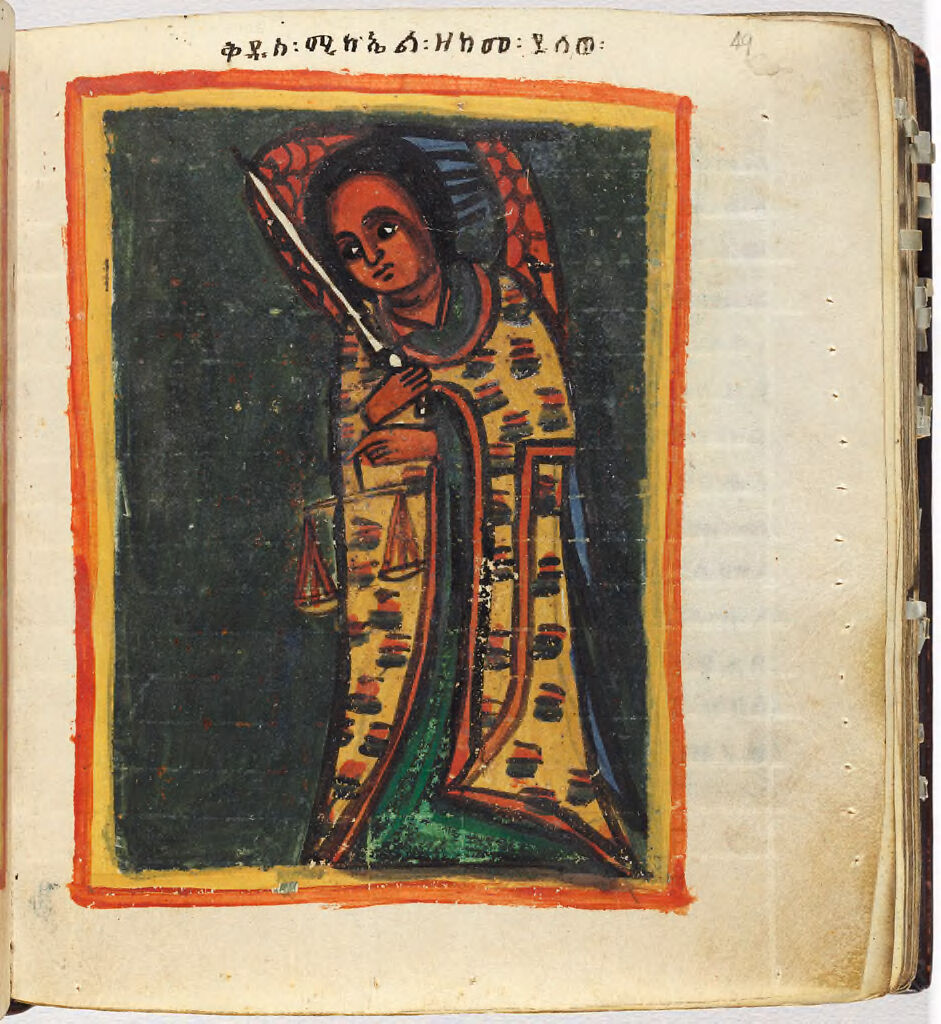
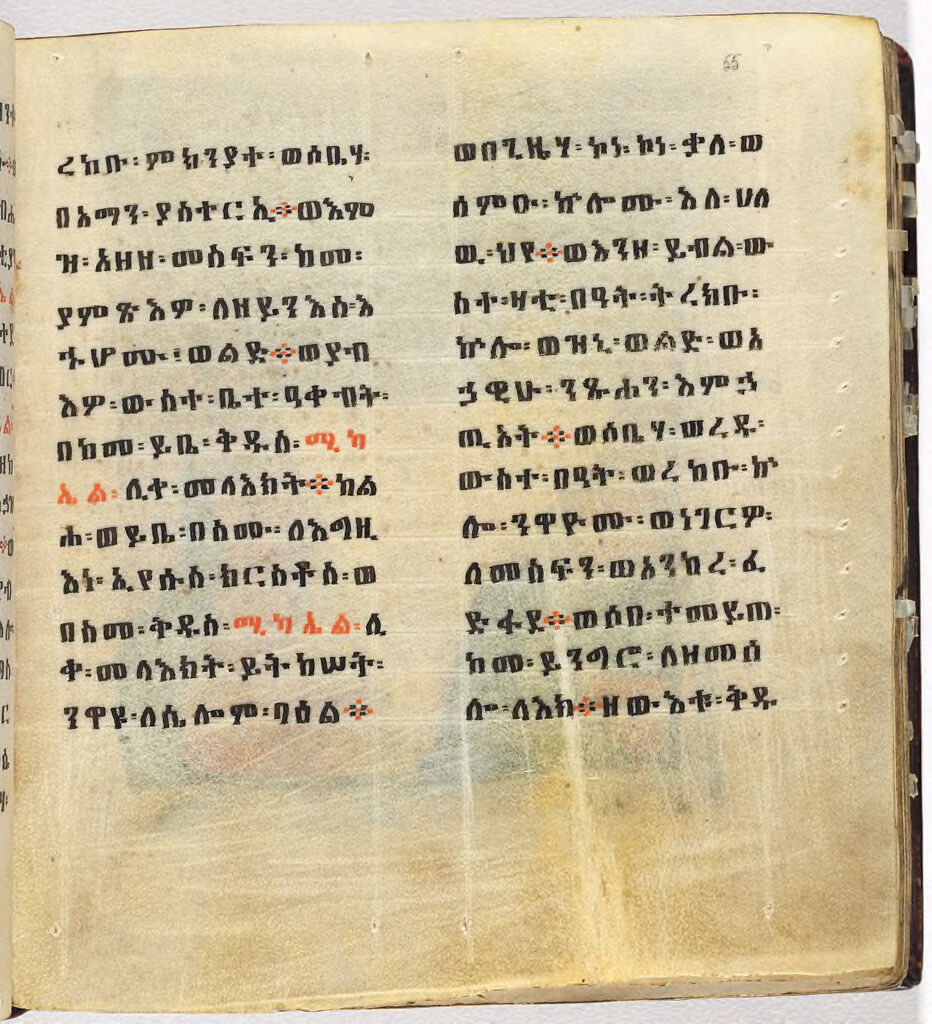
<p>For this part of the assignment, I picked Ethiopian objects. It is important to note that these objects were specifically characterized as “Ethiopian” and not “East African,” pointing to a higher degree of certainty regarding the origins of the objects. Unsurprisingly, most of the objects were of religious, particularly Christian, nature, as Ethiopia is known for its rich Orthodox Christian history. While the majority of the objects were religious manuscripts, some such as “Manuscript of Discourses on the Festivals of Saint Michael, with ninety-three paintings” and “Prayer Roll in Amharic” were the most viewed, while others such as “Leather Scroll: Ethiopian Prayers” and “A Manuscript Anthology of Religious Texts and Prayers in Amharic” were the least seen objects, which is puzzling as one would assume that the contents of these objects are equally important.</p>

<p><a href="https://harvardartmuseums.org/collections/object/215805?position=215805"> <img src="/assets/images/Ethiopian_1.jpeg" alt="Manuscript of Discourses on the Festivals of Saint Michael, with ninety-three paintings" /> </a></p>

<p><a href="https://harvardartmuseums.org/collections/object/215805?position=215805"> <img src="/assets/images/Ethiopian_2.jpeg" alt="Manuscript of Discourses on the Festivals of Saint Michael, with ninety-three paintings" /> </a></p>

<p>Once I visited the website, I understood that the reason why some were more ‘popular’ than others is due to the presence of images for the most viewed manuscripts and the lack of images for the least viewed ones. This is important because a visitor of the website, such as a professor of the history of Ethiopia or Christinaty, would be interested in seeing not only the descriptions of the objects, but also the contents of the manuscripts. The manuscripts that are the most viewed contain images of writings in Amharic, which could provide a great deal of information regarding the ways Ethiopian writers translated the Bible. This is likely the reason why the “Manuscript of Discourses on the Festivals of Saint Michael, with ninety-three paintings” has been seen more times than another highly viewed artwork “Prayer Roll in Amharic,” as the former is accompanied by higher resolution images, which make its writing more legible in comparison to the latter. Additionally, some of the highly viewed artworks contain images of paintings in the manuscripts, which provides a great deal of information about how Ethiopian artists depicted Christian Saints. This information is simply unaccessible in some of the least viewed artworks due to the lack of images for those objects.</p>

<h2 id="part-3">Part 3:</h2>

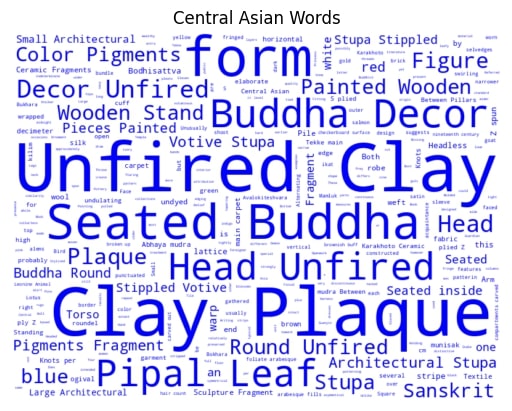
<p>For this part of the assignment, I decided to focus on three cultures that are historically connected: Central Asian, Turkic, and Iranian. There is a great deal of influence that these cultures had on each other, with “Central Asian” and “Turkic” sometimes being used interchangeably in modernity. At first, due to the indicated stop words, the wordclouds of all three cultures had a huge “nan” cluster. However, after having removed those in the code, interesting patterns began to emerge. One of the biggest clusters in the Central Asian wordcloud were the words “Buddha” and “Seated Buddha,” along with physical descriptions of the objects themselves such as “Unfired Clay” and “Wooden Stand.” The former clusters are particularly interesting due to the often overlooked history of Buddhism in Central Asia. The preserved art points to the artifacts that showcase that history. A look at the objects themselves on the HAM website reveals that the objects were connected to the Western Xia empire which had trade ties to Central Asia. Interestingly, the name of the city I am from in Kazakhstan (Semey) roughly translates to “Seven Tents,” which refer to the seven Buddhist temples that were found by Russian settlers.</p>

<p><img src="/assets/images/Central_Asian_wordcloud.jpg" alt="Central Asian wordcloud" /></p>

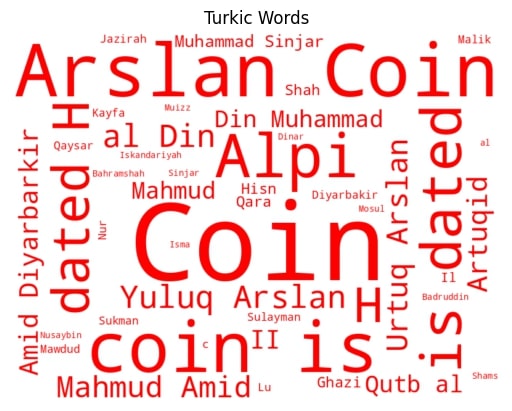
<p>The Turkic wordcloud contained two major worclouds “Arslan” and “Yuluq Arslan.” These are most likely associated with Husam al-Din Yuluq Arslan, who was a ruler of Artuqid dynasty. Interestingly, this dynasty spread over Eastern Turkey, higlighitng the connection between Asia Minor and Turkic identity.</p>

<p><img src="/assets/images/Turkic_wordcloud.jpg" alt="Turkic wordcloud" /></p>

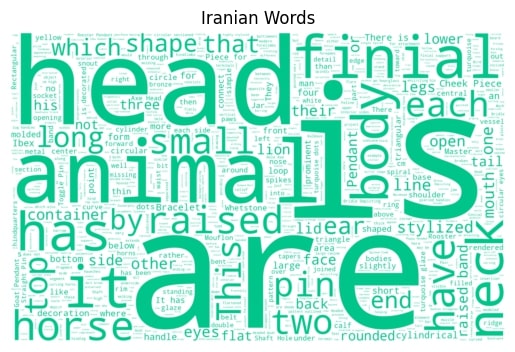
<p>Finally the Iranian wordcloud contained clusters such as “Animal,” “Head,” and “Body.” The HAM website shows that most of the objects labeled as “Iranian” are ceramic sculptures of animals.</p>

<p><img src="/assets/images/Iranian_wordcloud.jpg" alt="Iranian wordcloud" /></p>

<p>Most of the Central Asian objects were acquired in the year 1924, which coincides with the First Fogg Expedition to China (1923 - 1924). It is interesting to note that Central Asian objects, which were not originally found in Central Asia, ended up in a museum that is, once again, not in Central Asia.</p>

<p><img src="/assets/images/Accession_Year.jpg" alt="Accession Year" /></p>

<p>In conclusion, the analysis of Central Asian, Turkic, and Iranian artifacts reveals intricate historical connections. The digital method used in this analysis underscores the significance of interdisciplinary approaches in unraveling the intertwined histories of these cultures and their rich exchanges.</p>

<p><strong>Ready for Grading</strong></p>]]></content><author><name>Yerkebulan Imanbayev</name></author><category term="Assignment" /><category term="Central Asia" /><category term="WordCloud" /><category term="Harvard Art Museum" /><category term="PositCloud" /><summary type="html"><![CDATA[Part 1: For this part of the assignment, I decided to focus on art pieces on the Harvard Art Museum (HAM) website that have certain descriptions and lack others to produce a comparative analysis between the ways artworks are presented on the website and the “All_objects.csv” file. After analyzing a few such artworks, I concluded that the layout of the website and its limited focus on one specific artwork when it is selected presents a more isolated view of the artwork that removes it from its context. When one selects an artwork on the HAM website, a window appears that provides a comprehensive view of the description of the artwork, while occupying the entire screen of the user. While this allows for a more focused and detailed understanding of the artwork, it prevents one from understanding the piece in the context of similar artworks (from similar cultures, similar time periods, and/or that are acquired in the same year). However, one is able to see that in a CSV file by the means of filtering the data according to certain characteristics. For example, one of the descriptors of the artwork is its “accession year” - the year the artwork was acquired by the museum. Interestingly, the accession year is not available for all artworks, which could be for various reasons, such as anonymity, the human factor, etc. However, one is less likely to know about this lack of availability of the accession year due to the structure of the HAM website. If one only opens an artwork such as the “Triobol of the Aenianes of Thessaly” on the HAM website, one is unlikely to realize that the accession year is missing, because there is no writing that says “Accession Year: n. d.” (as there is in the case the date of the artwork is unavailable). However, viewing examining the CSV file will make it clear that there are artworks that have an accession year and some that don’t. This is important, as one is more likely to question the lack of the accession year that way. The CSV file and the accession year are also helpful in revealing potential details about the context in which the artwork was acquired: information that would probably not be deduced through the website alone. For example, the print “Actor OTANI TOMOJI AS A SAMURAI” was accessed in 1933, noted under “Japanese.” As one isn’t able to view similar artworks on the website, a quick look at the CSV file that filters for the same accession year and culture will locate a variety of other Japanese prints such as “Actor Ichikawa Monnosuke AS A KUMOSUKE” and “​​FIVE CEROMINIES OF THE YEAR CHERRY VIEWING” that were gifted to the university in the same year. These were all gifted by “the friends of Arthur B. Duel,” who most likely gifted his collection of Japanese artwork towards the final years of his life. In conclusion, the comparative analysis between the presentation of artworks on the Harvard Art Museum (HAM) website and the data provided in the “All_objects.csv” file highlights the differing perspectives offered by each platform. While the website provides a focused and detailed view of individual artworks, it often isolates them from their broader context, such as similar artworks from the same culture or time period. In contrast, the CSV file allows for a more comprehensive understanding by revealing patterns and details, such as the availability of accession years and the context of acquisition, which may not be readily apparent on the website. Part 2: For this part of the assignment, I picked Ethiopian objects. It is important to note that these objects were specifically characterized as “Ethiopian” and not “East African,” pointing to a higher degree of certainty regarding the origins of the objects. Unsurprisingly, most of the objects were of religious, particularly Christian, nature, as Ethiopia is known for its rich Orthodox Christian history. While the majority of the objects were religious manuscripts, some such as “Manuscript of Discourses on the Festivals of Saint Michael, with ninety-three paintings” and “Prayer Roll in Amharic” were the most viewed, while others such as “Leather Scroll: Ethiopian Prayers” and “A Manuscript Anthology of Religious Texts and Prayers in Amharic” were the least seen objects, which is puzzling as one would assume that the contents of these objects are equally important. Once I visited the website, I understood that the reason why some were more ‘popular’ than others is due to the presence of images for the most viewed manuscripts and the lack of images for the least viewed ones. This is important because a visitor of the website, such as a professor of the history of Ethiopia or Christinaty, would be interested in seeing not only the descriptions of the objects, but also the contents of the manuscripts. The manuscripts that are the most viewed contain images of writings in Amharic, which could provide a great deal of information regarding the ways Ethiopian writers translated the Bible. This is likely the reason why the “Manuscript of Discourses on the Festivals of Saint Michael, with ninety-three paintings” has been seen more times than another highly viewed artwork “Prayer Roll in Amharic,” as the former is accompanied by higher resolution images, which make its writing more legible in comparison to the latter. Additionally, some of the highly viewed artworks contain images of paintings in the manuscripts, which provides a great deal of information about how Ethiopian artists depicted Christian Saints. This information is simply unaccessible in some of the least viewed artworks due to the lack of images for those objects. Part 3: For this part of the assignment, I decided to focus on three cultures that are historically connected: Central Asian, Turkic, and Iranian. There is a great deal of influence that these cultures had on each other, with “Central Asian” and “Turkic” sometimes being used interchangeably in modernity. At first, due to the indicated stop words, the wordclouds of all three cultures had a huge “nan” cluster. However, after having removed those in the code, interesting patterns began to emerge. One of the biggest clusters in the Central Asian wordcloud were the words “Buddha” and “Seated Buddha,” along with physical descriptions of the objects themselves such as “Unfired Clay” and “Wooden Stand.” The former clusters are particularly interesting due to the often overlooked history of Buddhism in Central Asia. The preserved art points to the artifacts that showcase that history. A look at the objects themselves on the HAM website reveals that the objects were connected to the Western Xia empire which had trade ties to Central Asia. Interestingly, the name of the city I am from in Kazakhstan (Semey) roughly translates to “Seven Tents,” which refer to the seven Buddhist temples that were found by Russian settlers. The Turkic wordcloud contained two major worclouds “Arslan” and “Yuluq Arslan.” These are most likely associated with Husam al-Din Yuluq Arslan, who was a ruler of Artuqid dynasty. Interestingly, this dynasty spread over Eastern Turkey, higlighitng the connection between Asia Minor and Turkic identity. Finally the Iranian wordcloud contained clusters such as “Animal,” “Head,” and “Body.” The HAM website shows that most of the objects labeled as “Iranian” are ceramic sculptures of animals. Most of the Central Asian objects were acquired in the year 1924, which coincides with the First Fogg Expedition to China (1923 - 1924). It is interesting to note that Central Asian objects, which were not originally found in Central Asia, ended up in a museum that is, once again, not in Central Asia. In conclusion, the analysis of Central Asian, Turkic, and Iranian artifacts reveals intricate historical connections. The digital method used in this analysis underscores the significance of interdisciplinary approaches in unraveling the intertwined histories of these cultures and their rich exchanges. Ready for Grading]]></summary></entry><entry><title type="html">Assignment 2</title><link href="https://new-yerk.github.io/blog/assignment-2/" rel="alternate" type="text/html" title="Assignment 2" /><published>2024-02-06T00:00:00+00:00</published><updated>2024-02-06T00:00:00+00:00</updated><id>https://new-yerk.github.io/blog/assignment-2</id><content type="html" xml:base="https://new-yerk.github.io/blog/assignment-2/"><![CDATA[<p>When I first discovered the central topic of Assignment 2 - corpora of text - I knew immediately that I wanted to focus on the artistry and lyricism of Madonna. Known as one of the most controversial, yet innovative pop stars of all time, Madonna’s constant reinvention has broken barriers and influenced the pop world for generations to come. As someone who has become interested in her music and art, I was surprised to realize how masterfully she reinvented her imagery in the public eye with each new album: a move that granted her the title of “The Queen of Reinvention.” This change and its reflection of her vision at the time was something I was always interested in, as it speaks to the varying experiences and the shifting world around her that she was responding to.</p>
<p>As such, I decided to focus on three of her albums and the lyrics of all the songs on the albums that I would consider indicative of Madonna’s thematic range and how different each one of her “eras” is from the other ones. The three albums are “Like a Prayer,” “Erotica,” and “American Life.”</p>

<p>In 1989, Madonna released one of her most successful albums - “Like a Prayer.” Despite the heavy controversy that the lead, eponymous single of the album generated, it focused on her Catholic upbringing and revolved around the death of her mother, the relationship with her father and her then-husband Sean Penn. In many ways, this was a spiritual and introspective exploration of familial relationships. The concept of this album is what made her next album “Erotica” (1992) so much more jarring and scandalous. In “Erotica,” it feels as if Madonna became a completely different person, casting away matters of spiritually and focusing on her sexual desires. However, she also touched upon the political climate of the US at the time, where homophobic, racist, xenophobic, and transphobic attitudes were rampant. Finally, “American Life,” which was released in 2003 in the aftermath of the invasion of Iraq, saw Madonna fully diving into the themes of the American dream and materialism.</p>

<p>By using Voyant tools, I hope to gain a better understanding of the common themes and words that link the songs on each album and how much they actually differ from each other. I want to assess if the content of the songs matches the purported differences that were conveyed through the visual aspect of each era. Ultimately, I want to evaluate how much “re-invention” was actually taking place. In the following paragraphs, I will first analyze the different albums and their lyrical content by themselves and then focus on the differences between the albums. I will proceed in a chronological order.</p>

<p>I would like to emphasize that due to my usage of songs, there is bound to be repeated choruses and verses, which implies the repetition of words. In the initial stages of the project, I deleted the repetition and simply assessed the words by themselves. However, I soon realized that it would be an incomplete analysis as it would neglect Madonna’s intention in repeating those exact words and sentiments. Thus, I decided to include the songs in full as it would reflect their true meaning.</p>

<p>I decided to analyze the albums chronologically, which is why I’ll start with “Like a Prayer.”</p>

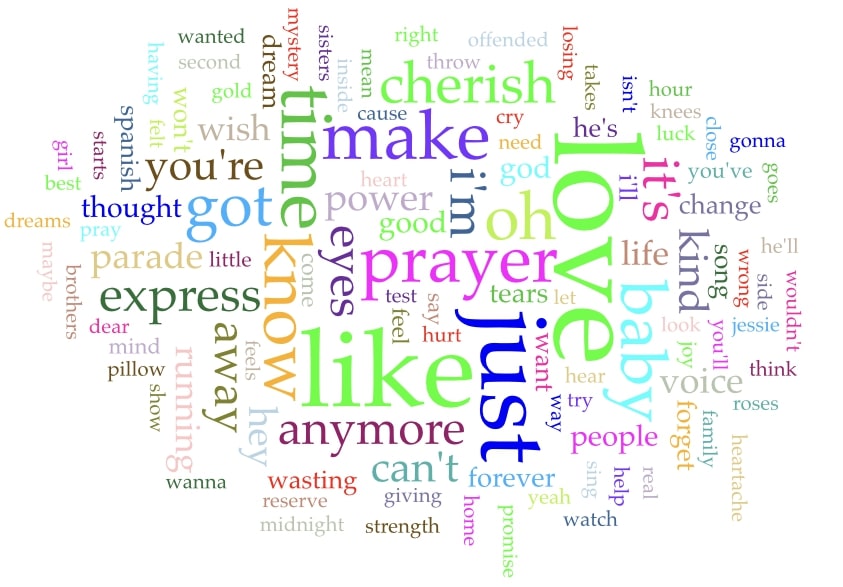
<p><img src="/assets/images/Like_A_Prayer.jpg" alt="&quot;Like a Prayer&quot; WordCloud" /></p>

<p>Generally, the most commonly used words on this album match the alleged introspective, family and religion-oriented nature of this album, with words such as “love,” “kind,” “prayer,” and “cherish” highlighting Madonna’s desire to speak about love and her Catholic upbringing. 
Interestingly, her next album “Erotica” is also notable for its heavy usage of the word “love.”</p>

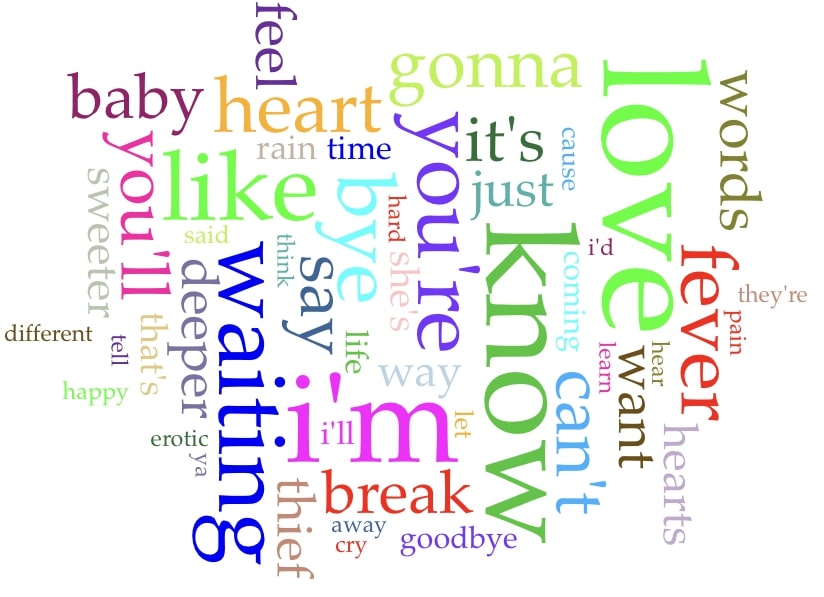
<p><img src="/assets/images/Erotica.jpg" alt="&quot;Like a Prayer&quot; WordCloud" /></p>

<iframe style="width: 444px; height: 408px;" src="https://voyant-tools.org/?corpus=ba353327c8331e3bc40f7e17cca97406&amp;view=Bubbles"></iframe>

<p>However, the context in which that word is used is markedly different from the songs in “Like a Prayer”. In “Erotica,” the word is mostly used in the context of heartbreak or urging societal change, with lines such as “Why’s it so hard to love one another?” underlining the state of social dynamics in the US at the time. Through the word cloud of  “Erotica,” we can see that this is a much darker album that deals with topics not only of the author’s erotic fantasies, as the title and words such as “want” and “fever” may suggest, but also due to its heavier discussion of heartbreak as the usage of “break,” “goodbye,” and “cry” indicate.</p>

<p>Finally, the most interesting word cloud came from the album “American Life.”</p>

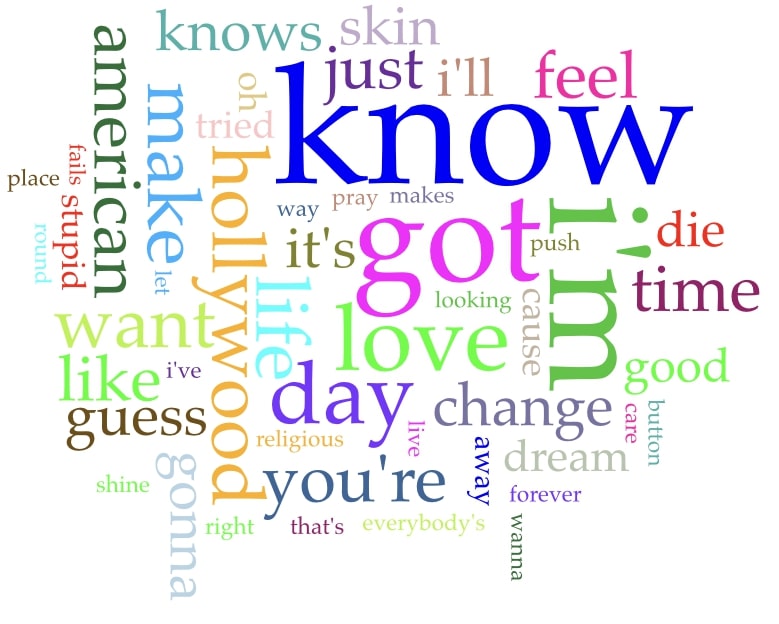
<p><img src="/assets/images/American_Life.jpg" alt="&quot;Like a Prayer&quot; WordCloud" /></p>

<p>As the image above suggests, this is a more politically and socially conscious album with some of the most commonly used words being “American,” “Hollywood,” and “dream.”</p>

<p>Surprisingly, the word “I’m” is the second most used word. At the time of the album’s release, critics panned the album for being “more about Madonna” than anything else, contrary to the marketing of the album that implied a more selfless, conscious approach to the state of the country. Investigating the album through Voyant Tools is helpful in analyzing if the album is, in fact, much more self-centered than what she described it as. Analyzing the context in which the phrase “I’m” is used, it becomes clear that when she uses it not to speak strictly from her perspective as Madonna, but as a citizen of the US, who is attempting to make sense of the contemporary, capitalist and pro-war sentiments, while attempting to live out the “American Dream.” In “Hollywood,” she sings “Music stations always play the same song, I’m bored with the concept of right and wrong.” In “Nobody Knows Me,” she sings</p>

<p>“No one’s telling me how to live my life</p>

<p>But it’s a setup and I’m just fed up</p>

<p>It’s no good when you’re misunderstood</p>

<p>But why should I care</p>

<p>What the world thinks of me?</p>

<p>Won’t let a stranger</p>

<p>Give me a social disease”</p>

<p>Here, one can clearly see that rather than speaking strictly from her own personal experiences or position of power, she takes on the perspective of an average citizen dealing with issues of societal pressure that many of us can relate to. This is not to say that her opinions about those perspectives are not influenced by her status as one of the most famous figures in Hollywood and by her wealth she has amassed: this is simply making space for a more nuanced conversation regarding whether “American Life” by Madonna is truly about American life.</p>

<p>In tracing Madonna’s thematic evolution across “Like a Prayer,” “Erotica,” and “American Life,” an interesting narrative emerges of artistic growth and reflection. Through analysis and digital tools, we uncover layers of meaning and societal commentary, showcasing Madonna’s ongoing exploration of self-expression and societal dynamics. Thus, her music becomes an interesting testament to the way artists can employ a combination of visual imagery, marketing, and lyricism in order to launch a new “reinvention” of their career.</p>]]></content><author><name>Yerkebulan Imanbayev</name></author><category term="Blog" /><category term="chat" /><category term="Post Formats" /><summary type="html"><![CDATA[When I first discovered the central topic of Assignment 2 - corpora of text - I knew immediately that I wanted to focus on the artistry and lyricism of Madonna. Known as one of the most controversial, yet innovative pop stars of all time, Madonna’s constant reinvention has broken barriers and influenced the pop world for generations to come. As someone who has become interested in her music and art, I was surprised to realize how masterfully she reinvented her imagery in the public eye with each new album: a move that granted her the title of “The Queen of Reinvention.” This change and its reflection of her vision at the time was something I was always interested in, as it speaks to the varying experiences and the shifting world around her that she was responding to.]]></summary></entry><entry><title type="html">Assignment 3</title><link href="https://new-yerk.github.io/blog/assignment-3/" rel="alternate" type="text/html" title="Assignment 3" /><published>2024-02-06T00:00:00+00:00</published><updated>2024-02-06T00:00:00+00:00</updated><id>https://new-yerk.github.io/blog/assignment-3</id><content type="html" xml:base="https://new-yerk.github.io/blog/assignment-3/"><![CDATA[<p>For this assignment, I decided to focus on the 1910 Smolensk Telephone book, which is one of the recommended sources retrieved from archive.org. Interestingly, the proper translation of the title of the telephone book is different from the one indicated on the website, as there is an additional phrase at the end: “the 1910 Smolensk Telephone Book, created and exploited by the government.”</p>

<p>The phone book has a relatively simple structure as denoted on page 6, and the descriptions of the callers follow the pattern of “Surname, Name, Last Name, and Apartment Number.” However, the actual descriptions deviate slightly from that as some of the callers in the phone book are not individuals but rather groups, businesses, or organizations. For example, one of the first groups noted on page 6 is the “Outpatient clinic for the care of the Sisters of Mercy community.” But even when the callers are individuals, their descriptions still deviate from the one mentioned above as for most of the people, their descriptions include their professions as well.</p>

<p>I proceeded to collect all of this data and put it into ChatGPT. My prompt was simple: “can you create a table that sorts this information by name, profession, and address?” Before beginning my work with the data, I cross listed the table that the software generated with the information in the phone book. Interestingly enough, the software was able to place the data in the categories relatively accurately, additionally recognizing that some of the objects in the phone book lacked a profession or an address. ChatGPT’s ability to do that becomes even more impressive when one takes into account the fact that the phone book employs old Russian, with letters and spelling that does not exist in the modern version of the language. That being said, it is important to note that the majority of the information was sorted incorrectly. The data that was put in was either missing completely, misspelled, or miscategorized. This is due to the fact that the pages of the phone book were scanned and turned into an archive, and, hence, the quality of the scan varies throughout the document. For this assignment, I attempted to use pages that are well-lit, as the text recognition feature was able to detect more information that way. Additionally the software was unable to differentiate between the letters “и” and “н,” thereby misspelling the words where those letters appeared. To improve the information, I returned to the phone book and corrected the information. The process of correcting the data required some time because, as I mentioned before, most of the information in the table was misspelled.</p>

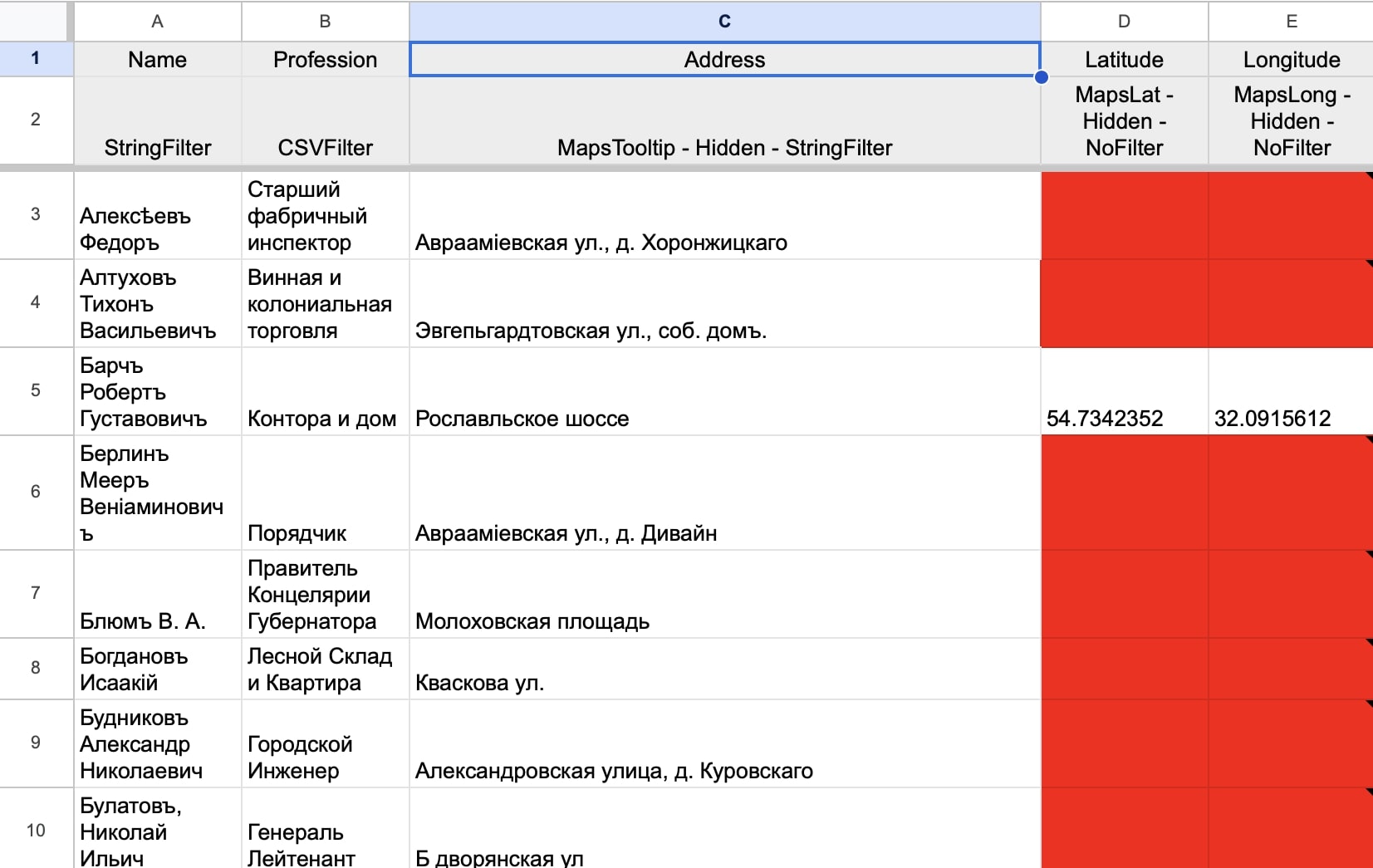
<p>All in all, I synthesized 51 rows of data, and used GeoCode to analyze the longitudinal and latitudinal information of the addresses in the table.</p>

<p><img src="/assets/images/The_Table.jpg" alt="The Table" title="The table with synthesized data" /></p>

<p>The end result was that GeoCode was able to retrieve information only for 13 out of the 51 rows. Once I noticed that, I decided to search for the addresses that are noted as red myself on Google Maps, and realized that Google Maps also lacks any information on those addresses. Not only were the streets missing, but any landmarks that could have potentially been named after that street were also missing in the Smolensk Oblast. The explanation for that seems to be an issue similar to the one we encountered in class: the titles of the streets must have been changed, which is expected, considering the fact that the phone book was created over a century ago. One of the addresses that was not recognized by GeoCode stood out to me: Molokhov square. This is a street that one cannot find on GoogleMaps. Instead, one can find a river called Molokhovka. Having looked up the history of Molokhov square, I discovered that it has been renamed “The Victory Square,” but used to be called “Molokhov” because of the river. As such, while the software itself was unable to recognize the address, further research unveils interesting details about the history of the Smolensk region and poses the question “Why was the software unable to recognize the river, as it has retained the same name?”</p>

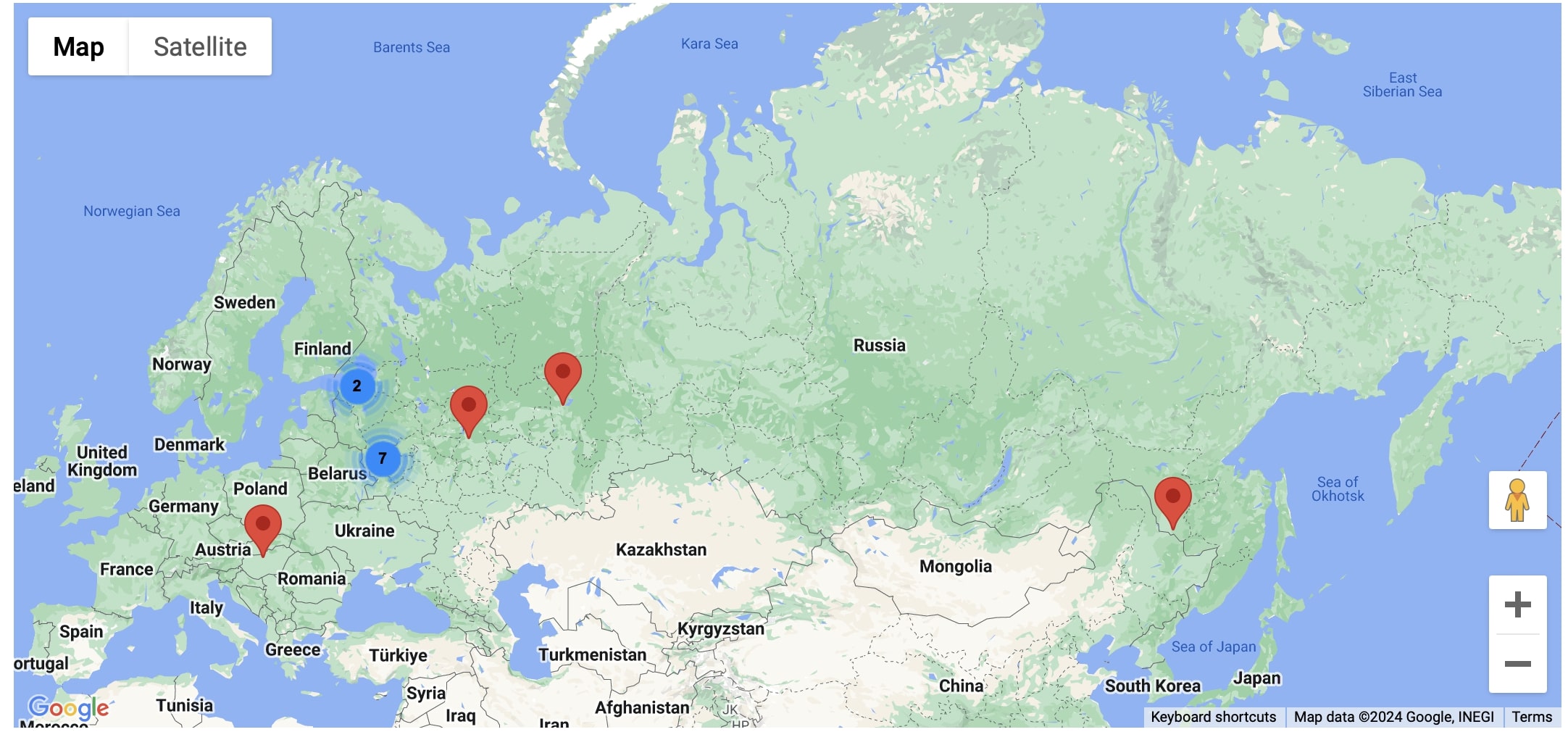
<p>Afterwards, I began examining the map generated by GeoCode itself.</p>

<p><img src="/assets/images/The_Map.jpg" alt="The Map" title="The generated map." /></p>

<p>Surprisingly, even for the data that GeoCode was able to successfully analyze, only 5 out of the 13 addresses point to the Smolensk region. The remaining addresses are either scattered throughout Russia or (as is the case for one of the points) are in Hungary. The 8 points that were placed incorrectly are once again, due to the fact that these addresses simply ceased to exist and similar ones were found in other places.</p>

<p>What becomes even more interesting is examining the 5 points that were placed correctly. Aside from two cases, these streets do not really exist anymore either: their names are preserved either by towns or small districts, yet the streets do not exist.</p>

<p>When I attempted to visualize the data using Google’s MyMaps, I continuously received an error that “the addresses could not be located.” As a result, I was unable to visualize the result and instead opted to continue analyzing the map provided by GeoCode. One of the questions that I kept asking myself throughout this process was “What is the significance of this?” “What can I learn from synthesizing so much data from a century-old telephone book?” In order to answer this question, I returned to the peculiar case of the Molokhov Square. I was interested to see why the square was renamed. In other words, I wanted to see why the name “Molokhov” was abandoned. Upon research I discovered that the name was abandoned during the October revolution of 1917. The reason for that was not apparent until I learned the history of one of the towers located at the Square. The tower, called “The Molokhov Tower,” bears its name because of the Romanov dynasty that ruled Russia for the centuries, and the renaming of that tower, and, subsequently, the square, was a way for protesters to renounce the legacy of the monarchy, which was one of the most prominent goals of the revolution. As such, just because of an analysis of a simple telephone book from a small region in Russia, I was able to learn about the details of one of Russia’s most important historical moments and its implications on something as seemingly insignificant as street names.</p>

<p>Going forward, I believe that such an analysis would prove to be more fruitful and productive if the archives that are used for it are either modernized or scanned in a much higher quality. Additionally, their digital analysis highly depends on the content and the language of those archives as I saw earlier because the software will most likely be able to successfully recognize only the modern version of that language.</p>

<p>In conclusion, the exploration of the 1910 Smolensk Telephone Book illuminates not only the daily lives and professions of individuals and organizations in early 20th-century Smolensk but also the challenges of data synthesis and historical interpretation. Despite hurdles such as outdated language, scanning quality, and geographical changes, this endeavor unveils layers of history, including political revolutions and societal transformations, that have left enduring imprints on the region. The discrepancies between recorded addresses and their present-day counterparts underscore the dynamic nature of urban landscapes and the importance of historical context in interpreting data accurately. Through digital analysis and contextualization, we uncover hidden narratives, demonstrating the enduring relevance of archival materials.</p>

<p>Ready for grading.</p>]]></content><author><name>Yerkebulan Imanbayev</name></author><category term="Blog" /><category term="Post Formats" /><category term="notice" /><summary type="html"><![CDATA[For this assignment, I decided to focus on the 1910 Smolensk Telephone book, which is one of the recommended sources retrieved from archive.org. Interestingly, the proper translation of the title of the telephone book is different from the one indicated on the website, as there is an additional phrase at the end: “the 1910 Smolensk Telephone Book, created and exploited by the government.”]]></summary></entry><entry><title type="html">Assignment 4</title><link href="https://new-yerk.github.io/blog/assignment-4/" rel="alternate" type="text/html" title="Assignment 4" /><published>2024-02-06T00:00:00+00:00</published><updated>2024-02-06T00:00:00+00:00</updated><id>https://new-yerk.github.io/blog/assignment-4</id><content type="html" xml:base="https://new-yerk.github.io/blog/assignment-4/"><![CDATA[]]></content><author><name>Yerkebulan Imanbayev</name></author><category term="Blog" /><category term="Post Formats" /><category term="quote" /><summary type="html"><![CDATA[]]></summary></entry></feed>