
Assignment 2
When I first discovered the central topic of Assignment 2 - corpora of text - I knew immediately that I wanted to focus on the artistry and lyricism of Madonna. Known as one of the most controversial, yet innovative pop stars of all time, Madonna’s constant reinvention has broken barriers and influenced the pop world for generations to come. As someone who has become interested in her music and art, I was surprised to realize how masterfully she reinvented her imagery in the public eye with each new album: a move that granted her the title of “The Queen of Reinvention.” This change and its reflection of her vision at the time was something I was always interested in, as it speaks to the varying experiences and the shifting world around her that she was responding to.
As such, I decided to focus on three of her albums and the lyrics of all the songs on the albums that I would consider indicative of Madonna’s thematic range and how different each one of her “eras” is from the other ones. The three albums are “Like a Prayer,” “Erotica,” and “American Life.”
In 1989, Madonna released one of her most successful albums - “Like a Prayer.” Despite the heavy controversy that the lead, eponymous single of the album generated, it focused on her Catholic upbringing and revolved around the death of her mother, the relationship with her father and her then-husband Sean Penn. In many ways, this was a spiritual and introspective exploration of familial relationships. The concept of this album is what made her next album “Erotica” (1992) so much more jarring and scandalous. In “Erotica,” it feels as if Madonna became a completely different person, casting away matters of spiritually and focusing on her sexual desires. However, she also touched upon the political climate of the US at the time, where homophobic, racist, xenophobic, and transphobic attitudes were rampant. Finally, “American Life,” which was released in 2003 in the aftermath of the invasion of Iraq, saw Madonna fully diving into the themes of the American dream and materialism.
By using Voyant tools, I hope to gain a better understanding of the common themes and words that link the songs on each album and how much they actually differ from each other. I want to assess if the content of the songs matches the purported differences that were conveyed through the visual aspect of each era. Ultimately, I want to evaluate how much “re-invention” was actually taking place. In the following paragraphs, I will first analyze the different albums and their lyrical content by themselves and then focus on the differences between the albums. I will proceed in a chronological order.
I would like to emphasize that due to my usage of songs, there is bound to be repeated choruses and verses, which implies the repetition of words. In the initial stages of the project, I deleted the repetition and simply assessed the words by themselves. However, I soon realized that it would be an incomplete analysis as it would neglect Madonna’s intention in repeating those exact words and sentiments. Thus, I decided to include the songs in full as it would reflect their true meaning.
I decided to analyze the albums chronologically, which is why I’ll start with “Like a Prayer.”
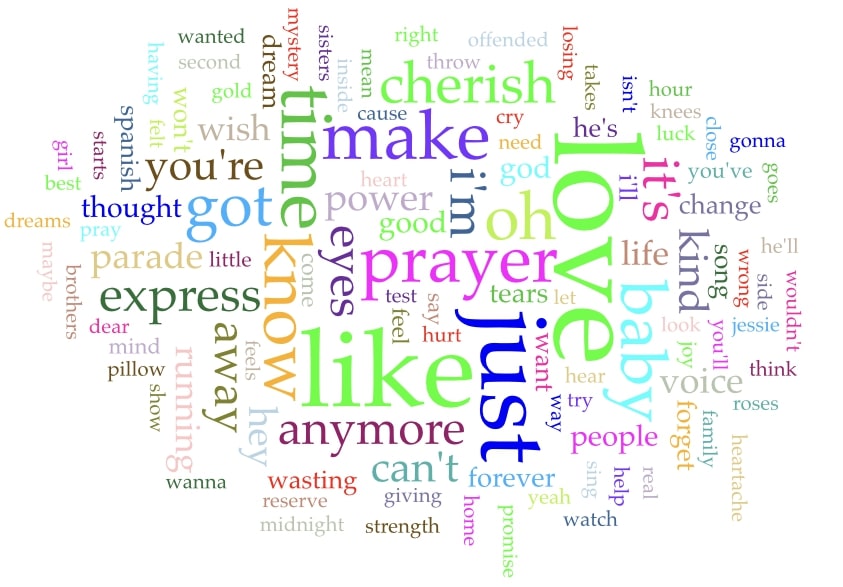
Generally, the most commonly used words on this album match the alleged introspective, family and religion-oriented nature of this album, with words such as “love,” “kind,” “prayer,” and “cherish” highlighting Madonna’s desire to speak about love and her Catholic upbringing. Interestingly, her next album “Erotica” is also notable for its heavy usage of the word “love.”
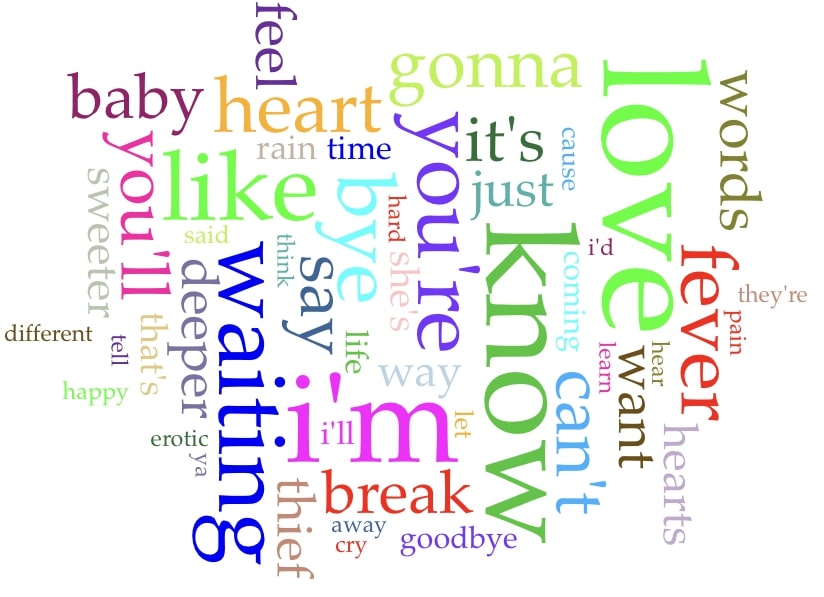
However, the context in which that word is used is markedly different from the songs in “Like a Prayer”. In “Erotica,” the word is mostly used in the context of heartbreak or urging societal change, with lines such as “Why’s it so hard to love one another?” underlining the state of social dynamics in the US at the time. Through the word cloud of “Erotica,” we can see that this is a much darker album that deals with topics not only of the author’s erotic fantasies, as the title and words such as “want” and “fever” may suggest, but also due to its heavier discussion of heartbreak as the usage of “break,” “goodbye,” and “cry” indicate.
Finally, the most interesting word cloud came from the album “American Life.”
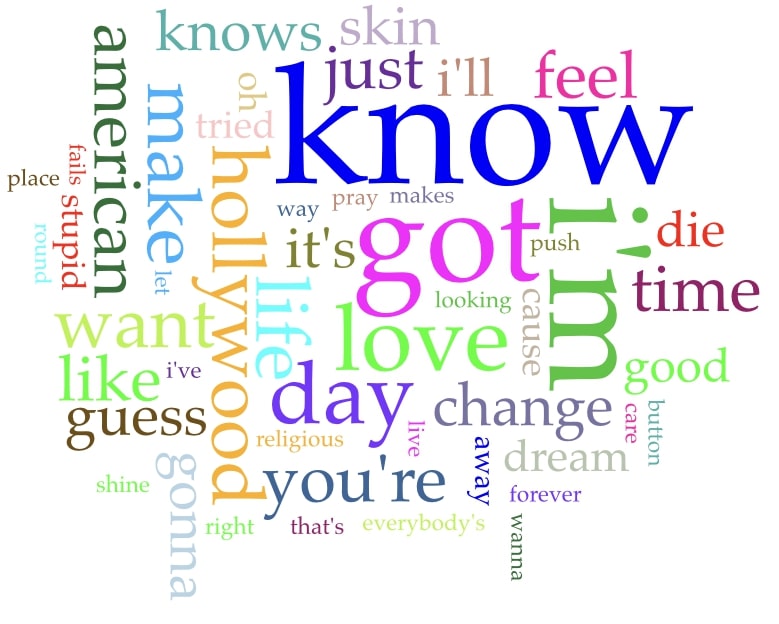
As the image above suggests, this is a more politically and socially conscious album with some of the most commonly used words being “American,” “Hollywood,” and “dream.”
Surprisingly, the word “I’m” is the second most used word. At the time of the album’s release, critics panned the album for being “more about Madonna” than anything else, contrary to the marketing of the album that implied a more selfless, conscious approach to the state of the country. Investigating the album through Voyant Tools is helpful in analyzing if the album is, in fact, much more self-centered than what she described it as. Analyzing the context in which the phrase “I’m” is used, it becomes clear that when she uses it not to speak strictly from her perspective as Madonna, but as a citizen of the US, who is attempting to make sense of the contemporary, capitalist and pro-war sentiments, while attempting to live out the “American Dream.” In “Hollywood,” she sings “Music stations always play the same song, I’m bored with the concept of right and wrong.” In “Nobody Knows Me,” she sings
“No one’s telling me how to live my life
But it’s a setup and I’m just fed up
It’s no good when you’re misunderstood
But why should I care
What the world thinks of me?
Won’t let a stranger
Give me a social disease”
Here, one can clearly see that rather than speaking strictly from her own personal experiences or position of power, she takes on the perspective of an average citizen dealing with issues of societal pressure that many of us can relate to. This is not to say that her opinions about those perspectives are not influenced by her status as one of the most famous figures in Hollywood and by her wealth she has amassed: this is simply making space for a more nuanced conversation regarding whether “American Life” by Madonna is truly about American life.
In tracing Madonna’s thematic evolution across “Like a Prayer,” “Erotica,” and “American Life,” an interesting narrative emerges of artistic growth and reflection. Through analysis and digital tools, we uncover layers of meaning and societal commentary, showcasing Madonna’s ongoing exploration of self-expression and societal dynamics. Thus, her music becomes an interesting testament to the way artists can employ a combination of visual imagery, marketing, and lyricism in order to launch a new “reinvention” of their career.