
Assignment 3
For this assignment, I decided to focus on the 1910 Smolensk Telephone book, which is one of the recommended sources retrieved from archive.org. Interestingly, the proper translation of the title of the telephone book is different from the one indicated on the website, as there is an additional phrase at the end: “the 1910 Smolensk Telephone Book, created and exploited by the government.”
The phone book has a relatively simple structure as denoted on page 6, and the descriptions of the callers follow the pattern of “Surname, Name, Last Name, and Apartment Number.” However, the actual descriptions deviate slightly from that as some of the callers in the phone book are not individuals but rather groups, businesses, or organizations. For example, one of the first groups noted on page 6 is the “Outpatient clinic for the care of the Sisters of Mercy community.” But even when the callers are individuals, their descriptions still deviate from the one mentioned above as for most of the people, their descriptions include their professions as well.
I proceeded to collect all of this data and put it into ChatGPT. My prompt was simple: “can you create a table that sorts this information by name, profession, and address?” Before beginning my work with the data, I cross listed the table that the software generated with the information in the phone book. Interestingly enough, the software was able to place the data in the categories relatively accurately, additionally recognizing that some of the objects in the phone book lacked a profession or an address. ChatGPT’s ability to do that becomes even more impressive when one takes into account the fact that the phone book employs old Russian, with letters and spelling that does not exist in the modern version of the language. That being said, it is important to note that the majority of the information was sorted incorrectly. The data that was put in was either missing completely, misspelled, or miscategorized. This is due to the fact that the pages of the phone book were scanned and turned into an archive, and, hence, the quality of the scan varies throughout the document. For this assignment, I attempted to use pages that are well-lit, as the text recognition feature was able to detect more information that way. Additionally the software was unable to differentiate between the letters “и” and “н,” thereby misspelling the words where those letters appeared. To improve the information, I returned to the phone book and corrected the information. The process of correcting the data required some time because, as I mentioned before, most of the information in the table was misspelled.
All in all, I synthesized 51 rows of data, and used GeoCode to analyze the longitudinal and latitudinal information of the addresses in the table.
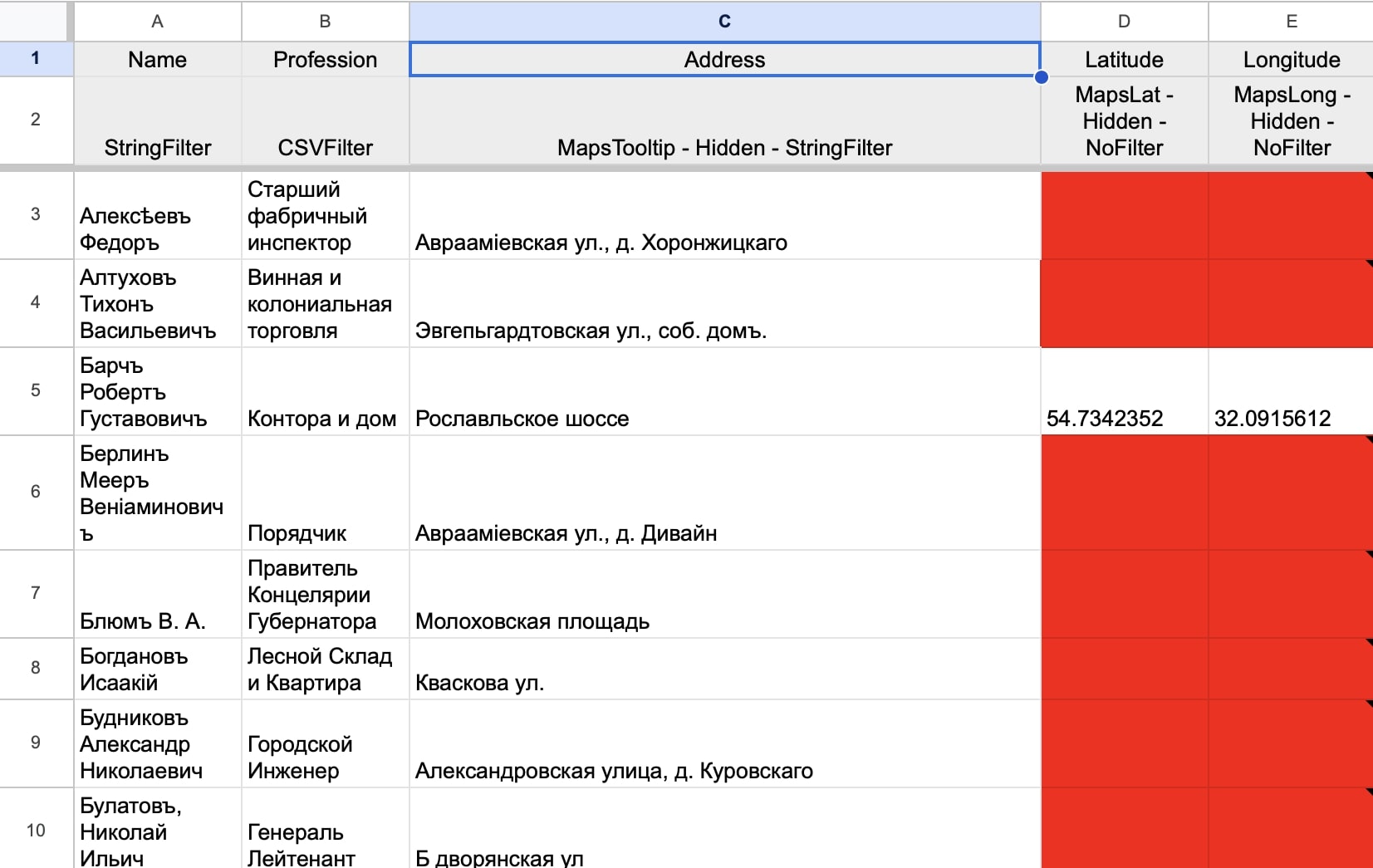
The end result was that GeoCode was able to retrieve information only for 13 out of the 51 rows. Once I noticed that, I decided to search for the addresses that are noted as red myself on Google Maps, and realized that Google Maps also lacks any information on those addresses. Not only were the streets missing, but any landmarks that could have potentially been named after that street were also missing in the Smolensk Oblast. The explanation for that seems to be an issue similar to the one we encountered in class: the titles of the streets must have been changed, which is expected, considering the fact that the phone book was created over a century ago. One of the addresses that was not recognized by GeoCode stood out to me: Molokhov square. This is a street that one cannot find on GoogleMaps. Instead, one can find a river called Molokhovka. Having looked up the history of Molokhov square, I discovered that it has been renamed “The Victory Square,” but used to be called “Molokhov” because of the river. As such, while the software itself was unable to recognize the address, further research unveils interesting details about the history of the Smolensk region and poses the question “Why was the software unable to recognize the river, as it has retained the same name?”
Afterwards, I began examining the map generated by GeoCode itself.
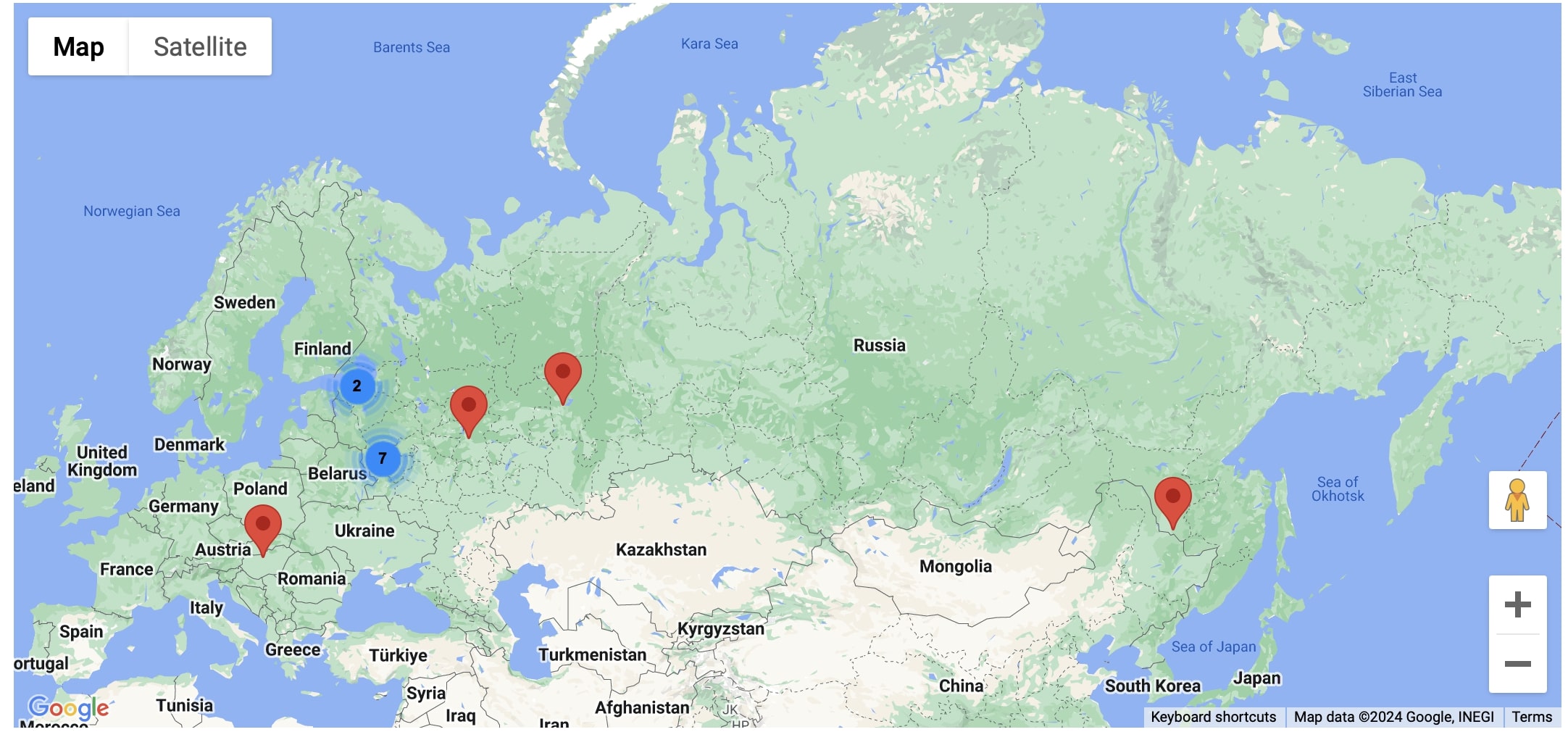
Surprisingly, even for the data that GeoCode was able to successfully analyze, only 5 out of the 13 addresses point to the Smolensk region. The remaining addresses are either scattered throughout Russia or (as is the case for one of the points) are in Hungary. The 8 points that were placed incorrectly are once again, due to the fact that these addresses simply ceased to exist and similar ones were found in other places.
What becomes even more interesting is examining the 5 points that were placed correctly. Aside from two cases, these streets do not really exist anymore either: their names are preserved either by towns or small districts, yet the streets do not exist.
When I attempted to visualize the data using Google’s MyMaps, I continuously received an error that “the addresses could not be located.” As a result, I was unable to visualize the result and instead opted to continue analyzing the map provided by GeoCode. One of the questions that I kept asking myself throughout this process was “What is the significance of this?” “What can I learn from synthesizing so much data from a century-old telephone book?” In order to answer this question, I returned to the peculiar case of the Molokhov Square. I was interested to see why the square was renamed. In other words, I wanted to see why the name “Molokhov” was abandoned. Upon research I discovered that the name was abandoned during the October revolution of 1917. The reason for that was not apparent until I learned the history of one of the towers located at the Square. The tower, called “The Molokhov Tower,” bears its name because of the Romanov dynasty that ruled Russia for the centuries, and the renaming of that tower, and, subsequently, the square, was a way for protesters to renounce the legacy of the monarchy, which was one of the most prominent goals of the revolution. As such, just because of an analysis of a simple telephone book from a small region in Russia, I was able to learn about the details of one of Russia’s most important historical moments and its implications on something as seemingly insignificant as street names.
Going forward, I believe that such an analysis would prove to be more fruitful and productive if the archives that are used for it are either modernized or scanned in a much higher quality. Additionally, their digital analysis highly depends on the content and the language of those archives as I saw earlier because the software will most likely be able to successfully recognize only the modern version of that language.
In conclusion, the exploration of the 1910 Smolensk Telephone Book illuminates not only the daily lives and professions of individuals and organizations in early 20th-century Smolensk but also the challenges of data synthesis and historical interpretation. Despite hurdles such as outdated language, scanning quality, and geographical changes, this endeavor unveils layers of history, including political revolutions and societal transformations, that have left enduring imprints on the region. The discrepancies between recorded addresses and their present-day counterparts underscore the dynamic nature of urban landscapes and the importance of historical context in interpreting data accurately. Through digital analysis and contextualization, we uncover hidden narratives, demonstrating the enduring relevance of archival materials.
Ready for grading.